Architecture governance does not have a quality problem, it has a speed and scalability challenge.
The standards exist and the architects are capable, but when a delivery team needs a technology decision reviewed, they are working to a sprint cadence while governance is working to a calendar, and that gap between when decisions need a review and when governance can provide one is what cajeX architecture review automation is built to close.
This post covers how automation changes the review model, why consistency at scale matters as much as speed, and how teams get started without months of setup work.
The Productivity Problem Nobody Wants to Name
Enterprise architecture teams have never been under greater pressure. Executive leadership expects them to accelerate digital transformation, reduce technology costs, rationalise application portfolios, improve business agility, and support AI initiatives, all while maintaining an accurate governance repository. Yet most EA teams are expected to achieve these objectives with the same budget and the same number of architects they had years ago.
When the workload grows faster than the team, the traditional responses are familiar: hire more architects, replace the EA platform, or push the existing team to cover more ground. Each has the same fundamental problem: hiring is costly and slow, with experienced enterprise architects taking months to recruit and months more to become effective; new platforms are disruptive and expensive; and asking the existing team to work harder is not a scalability strategy but a way of deferring a structural problem until it becomes a people problem.
None of these responses addresses the underlying issue. As Lambert and Murphy observed in their 2026 analysis of EA productivity, many EA teams spend much of their time on activities that deliver little direct business value: manually documenting applications, updating capability maps, maintaining inventories, reconciling inconsistent information, preparing presentations, and responding to ad hoc requests from project teams. As enterprise complexity grows, these activities consume an increasing share of the team's capacity, leaving progressively less time for the work that actually requires architectural judgment. Gartner projects that up to 50% of these low-level EA tasks, including compliance checks, reporting, and diagram generation, could be automated by 2028, freeing architects for the strategic work that current workloads leave little room for.
The result is also familiar. Enterprise architecture repositories become outdated, stakeholders lose confidence in the information, and architects spend more time maintaining documentation than helping executives make strategic decisions. This is not a technology problem but a productivity and scalability one, and the architecture review queue is one of its most visible symptoms.
Three Structural Causes of the Bottleneck
Availability dependency. Every traditional architecture review depends on the right people being available at the same time. When senior architects are stretched across multiple workstreams, which is the normal condition rather than the exception, reviews wait. ClearRoute's State of the Route to Live 2026, drawing on four years of delivery assessments across financial services, retail, healthcare, and technology, found that median enterprise lead time to production remains 30 to 45 days, with governance and approval bottlenecks explicitly cited as a primary cause. In one assessed organisation, a business-critical feature took 266 days to reach production.
The agile delivery paradox. Most delivery teams operate in two-week sprints. They make technology choices, vendor selections, and architectural decisions at a pace that agile methods were designed to enable. Yet the governance model those decisions flow through has not changed to match. Architecture review remains a waterfall process sitting inside an agile organisation: a sequential, scheduled, committee-dependent checkpoint that was designed for a slower world. The result is a collision between two operating rhythms: delivery teams moving at sprint speed, governance moving at quarter speed. Self-service architecture review is what closes that gap, giving delivery teams the agility to govern their own decisions at the moment they are being made, with findings generated immediately rather than weeks later.
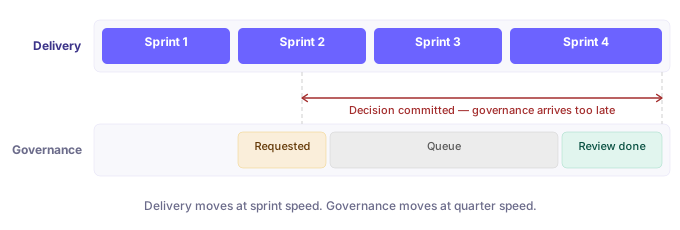
Figure 1 — Delivery moves at sprint speed. Governance moves at quarter speed.
Late positioning in the decision cycle. By the time most architecture reviews are scheduled, the decision being reviewed has already been shaped by informal conversations, sprint planning, and vendor evaluations already underway. Architecture that arrives after the fact can only confirm or contest a decision that has already become expensive to reverse. Writing in Architecture & Governance Magazine, Rajjie Sarmey calls this the Timing Gap: the distance between when an organisation knows what to do and when it is able to do it, driven not by a lack of vision but by institutional latency trapped between approval layers, governance checkpoints, and architectural indecision. The greatest value of enterprise architecture lies in its ability to connect business strategy with execution. That connection requires governance to be present when decisions are being made, not after they have been locked in.
These three causes reinforce each other. Because reviews are slow to schedule, teams make decisions without waiting for them, and because those decisions arrive without governance input, reviews land too late to shape them, leaving findings that are hard to act on and a process whose perceived value declines precisely when it needs to improve.
The Volume Problem Is Getting Worse
The bottleneck would be challenging enough at current decision volumes. But the volume of decisions requiring architectural review is growing, driven by the pace of technology and business change.
AI adoption is accelerating the rate at which organisations make technology choices: new vendors are evaluated, new SaaS platforms procured, new integrations built, new cloud configurations deployed. Each carries architectural and governance implications. GitLab's 2025 Global DevSecOps Report, surveying more than 3,000 respondents, named this the "AI Paradox": coding accounts for only 20% of the software lifecycle, and the downstream activities, including governance, review, security, and compliance, have not scaled to match the generation side.
The implication for architecture governance is direct: the surface area requiring review is expanding, expectations on architects are rising, and a process built around human availability and calendar scheduling does not have the scalability to keep pace with either.
What Architecture Review Automation Changes
Architecture review automation does not replace the judgment of experienced architects. It removes the scheduling dependency that has made that judgment unavailable at the moments that matter most, and it applies that judgment consistently, at scale, to every decision that requires it.
The mechanism is the architecture directive: a single, structured, approved rule specifying what your organisation requires. When architects approve a set of directives, those directives are applied automatically to any submission by an AI co-worker that evaluates the submission against the full active directive set and generates findings classified by severity and type. The submission can be a solution design, a technology selection, a vendor evaluation, a business case, or an infrastructure decision.
The review that used to take six weeks to schedule now happens the same day, the consistency that depended on whoever happened to run the review is now determined by the directive set itself, and teams can run a self-service review at the moment a decision is being made, before any commitment is locked in. Architects remain responsible for validating critical findings and strategic trade-offs, with the AI handling the volume so senior architects can focus on the judgments that genuinely require their experience.
Critically, this is not a replacement for the EA platform your team already uses. It is the governance enforcement layer that sits alongside it, applying the standards your EA platform documents at the speed decisions are actually made. For more on how the review pipeline works in practice, see AI Architecture Review: What Actually Happens Under the Hood.
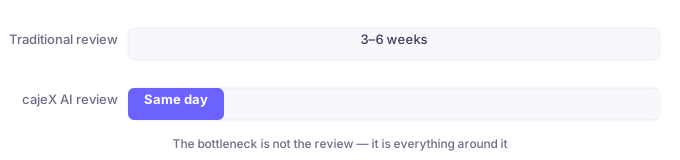
Figure 2 — Traditional review vs. cajeX AI review. The bottleneck is not the review, it is everything around it.
The Consistency Argument
Inconsistency in architecture review is underrated as a governance problem because its effects accumulate quietly over time: delivery teams learn which architects give thorough reviews and which give easy ones, standards that should be non-negotiable get negotiated project by project, and the governance standard drifts without anyone deciding to change it, simply because individual variation in review quality has changed it in practice.
AI-powered review automation applies the same directive set to every submission, every time. The finding generated for a missing security control is the same regardless of team size, project seniority, or the day of the week. The standard is what it says it is, and governance becomes genuinely consistent in a way that human review, however well-intentioned, cannot reliably achieve at scale.
This consistency also makes the governance data useful in a new way. When every finding maps to a specific directive, the portfolio-level view becomes meaningful: which directives are generating the most findings, which are rarely triggered, and which are generating findings that teams consistently accept as risks rather than resolve. That feedback loop is what the Directive Intelligence feature makes visible.
Getting Started Without the Blank Page Problem
The most common objection to adopting architecture review automation is not about the reviews themselves but about getting there, since building a directive library from scratch can feel like months of work before any value is realised.
The Frameworks Library closes that gap. 300+ regulatory and industry frameworks are available, covering NIS2, DORA, GDPR, EU AI Act, ISO 27001, NIST CSF, IATF 16949, and hundreds more, directly inside cajeX, each pre-mapped into structured directives ready for AI review. Select the frameworks that apply, review the suggested clause-to-directive mappings, approve what fits, and refine what does not. The first AI review runs against a governed directive set on day one.
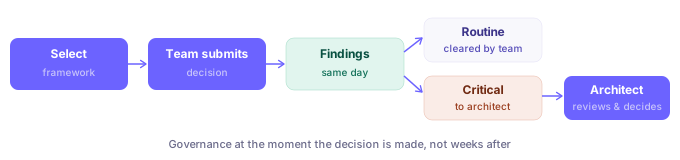
Figure 3 — Governance at the moment the decision is made, not weeks after.
For organisations with existing standards in PDFs, Confluence, or SharePoint, the cajeX AI co-worker reads that documentation and extracts candidate directives. The architecture team reviews and approves them. Rather than replacing existing investments, organisations extract greater value from the knowledge and tools they already have.
The bottleneck is not a law of physics but a consequence of a review process designed for a pace that no longer exists, and architecture review automation does not eliminate the need for architectural judgment. It gives that judgment the scalability and agility that governance has always needed but never had.
Sources
- Lambert, D. and Murphy, S., "Unlock More Business Value from Enterprise Architecture Without Hiring More Staff", Business Architecture Info, 2026
- Sarmey, R., "The Timing Gap: Why Enterprises Fail Not from Disruption, but from Delayed Architecture Decisions", Architecture & Governance Magazine, February 2026
- "Enterprise Architecture in 2026: Trends, Skills, and Strategies", Avolution, citing Gartner, 2026
- "State of the Route to Live 2026", ClearRoute, 2026
- "Global DevSecOps Report 2025", GitLab, 2025