With a new platform or application it can feel overwhelming, hard to get started, or get the feeling of true value being generated. Whether the company has an established architecture governance framework or an agile approach, cajeX is here to support.
- cajeX can help established architecture governance teams by collecting all the company's architectural knowledge in one place and support the team in scaling design review work.
- Companies starting up their architecture governance journey or identifying the right framework, cajeX can support managing the right directives to focus on based on the framework and company strategy.
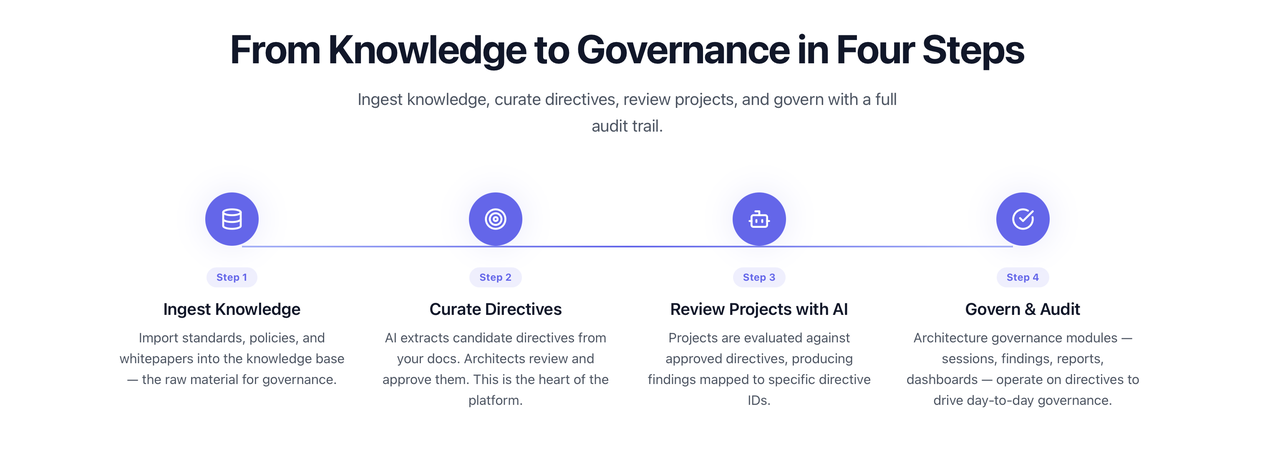
From Knowledge to Governance in Four Steps
Start the cajeX journey by following the four-step approach — From Knowledge to Governance in Four Steps. The approach will help steer the technology road map, linking your directives to findings, and will support the company going forward in working with technical debt and architectural drift, which might impact current or future technology strategy.
Start with setting up your Knowledge Base (KB) and Directives before any other activities to get the value of the AI Co-Worker.
Knowledge Base (KB)
Define KBs by building up government or industry regulations that apply to the company. Or add best practices knowledge by linking to websites, uploading documents, or combining both into a KB card. Collect the fragmented knowledge of the company into a common repository and power it with an AI Co-Worker to produce structured knowledge.
- Create from existing material — how the company is adopting regulations, standards, policies, or whitepapers. The KB can be used later to create Directives and serves as the company architecture knowledge repository for employees to find information.
- Build new KBs with the AI Co-Worker by linking to regulatory or government websites, uploading documents, and adding additional information or focus areas for the Co-Worker to build the KB card.
The AI Co-Worker provides the architecture governance team an overview in the KB card to approve, building the company knowledge base for governmental and industry regulation adoptions. The AI will learn and understand the organisation's unique context. This first step lays the foundation for Directives, which is the company architecture governance framework to support project implementation being compliant.
Directives
After setting up the Knowledge Base (KB), the next step is to create the first Directives by uploading existing Directives that apply to the company today or by creating new Directives with the Co-Worker.
- Using KBs to create Directives — get the AI Co-Worker to help with building your first Directives by using the AI Generate functionality within the Directives module.
- If your company has a vast number of existing documents with architecture governance content, it's an opportunity to review them and create them as Directives within cajeX.
- Cross-reference for duplicates and overlaps — the AI Co-Worker will cross-reference the Directives for duplications and overlaps, and provide an overview between the impacted Directives for the architects to review and approve.
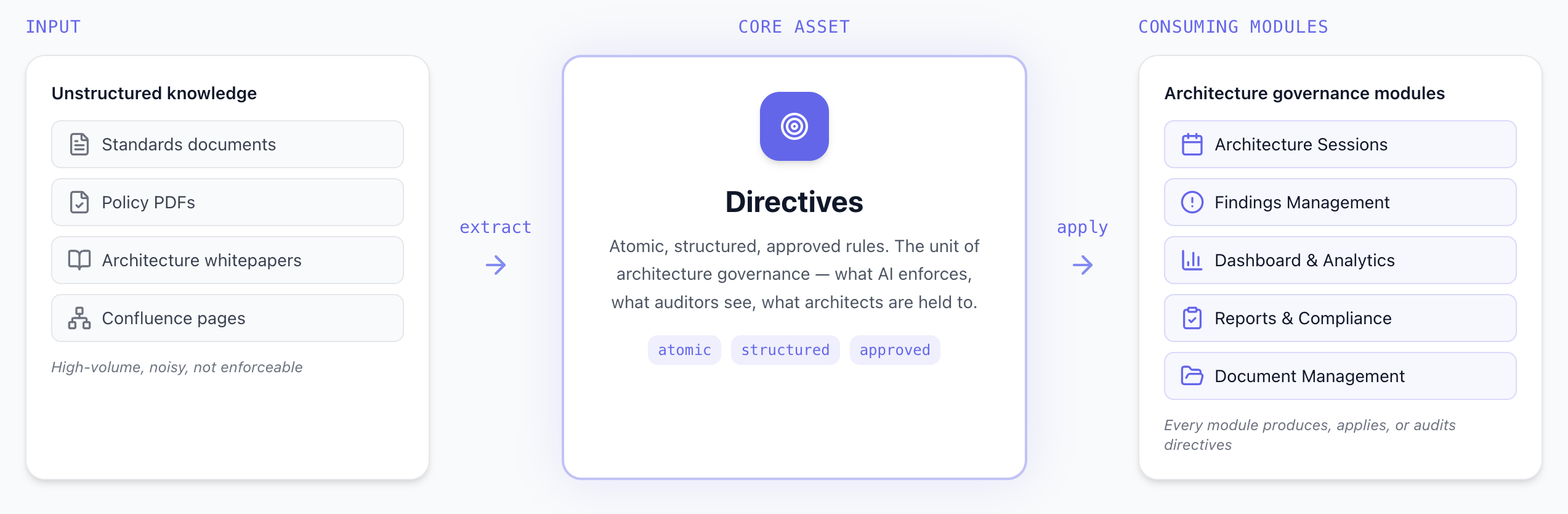
With cajeX Directives, unstructured knowledge becomes approved directives, and every architecture governance module on the platform produces, applies, or audits the directives. The Architecture Governance team can build company-specific frameworks and assign directives to phases in the governance process or project categories.
Review Projects
With the Knowledge Base and Directives set, let's get going on the first project review. Like Knowledge Base (KB) and Directives, Projects can be created in two ways: AI Co-Worker supported, or manual entry of information.
- Co-Worker assisted Project creation — cajeX can help with creating the project card based on the documents related to the project by uploading relevant documents. The user can add additional information with a short description and instructions to the Co-Worker.
- Manual entry — the user can also select to enter the project information manually by selecting "New Project". Project documents from presentations, solution designs, and requirements can be uploaded to the project card. The information will be used for project review.
cajeX focuses on a democratic approach to project reviews, where directives and the derived knowledge are accessible for the entire organisation through the Knowledge and Directives modules. Project team members and architects collaborate to ensure project success, and architecture governance is not a technical bottleneck with technical documentation and terms only understood within the IT and technology organisation.
Findings
What happens after projects have gone through review sessions? In most companies, the most critical findings are mitigated through an agreement between project team and architecture governance team to solve the finding (or re-write part of the design), so the solution design is compliant.
Working with Findings in cajeX is different. Findings are not a remark on the project so it can pass a gate in the governance framework — they are a structured way of working with technical debt and architectural drift.
- Findings linked to specific architecture directives
- Resolution tracking with evidence attachment

Findings from project reviews are linked to specific Directives — an easy and structured method providing an overview to understand the company compliance level derived from the Knowledge Base. Each finding has a severity, a recommended fix, and a clear owner. Nothing gets lost, because every finding requires explicit resolution or an accepted risk waiver.
All Findings have an impact on the company technology strategy and road map. cajeX enables the architect team and senior management to keep track of decisions that could influence the future. cajeX will move architecture governance beyond bureaucracy to provide clear standards, accountability, and strategic alignment, rather than having architect teams merely acting as "roadblocks" for project and development teams.
The Architecture Governance team's core activities are to provide effective governance — through strategic direction and clear guidance to delivery teams — with accountability of the technology landscape to senior management.